

The Six Resources That Got Me Through The Silmarillion
I first read The Hobbit and The Lord of the Rings in the 90’s. Naturally, the following book I picked up was The Silmarillion. I did not finish it. Nor did I make much progress in the early 2000’s when the hype around Peter Jackson’s films was at its peak. I kept putting down The Silmarillion because it felt like a dry history textbook full of unfamiliar characters and places. For 20 years, I assumed that the book just wasn’t for me, a casual fan of J.R.R. Tolkien’s mainstream works.
My most recent attempt started in 2024, in response to the Amazon series The Rings of Power. This time I successfully finished, and enjoyed, The Silmarillion. This accomplishment was largely due to certain resources that Tolkien’s fans have created. I’d like to highlight these resources for anyone else who has experienced challenges finishing The Silmarillion.
The Prancing Pony Podcast begins as a chapter by chapter discussion of The Silmarillion by the hosts Alan Sisto and Shawn Marchese. They are very knowledgeable about Tolkien’s works, and bring much needed context to the themes of The Silmarillion and its connections to Tolkien’s other works. The hosts recommend a book club approach, where the listener reads a chapter before listening to that chapter’s discussion. I found it most efficient to listen to an episode, and then read the corresponding text. Either way, I largely attribute my successful reading of The Silmarillion to this podcast.
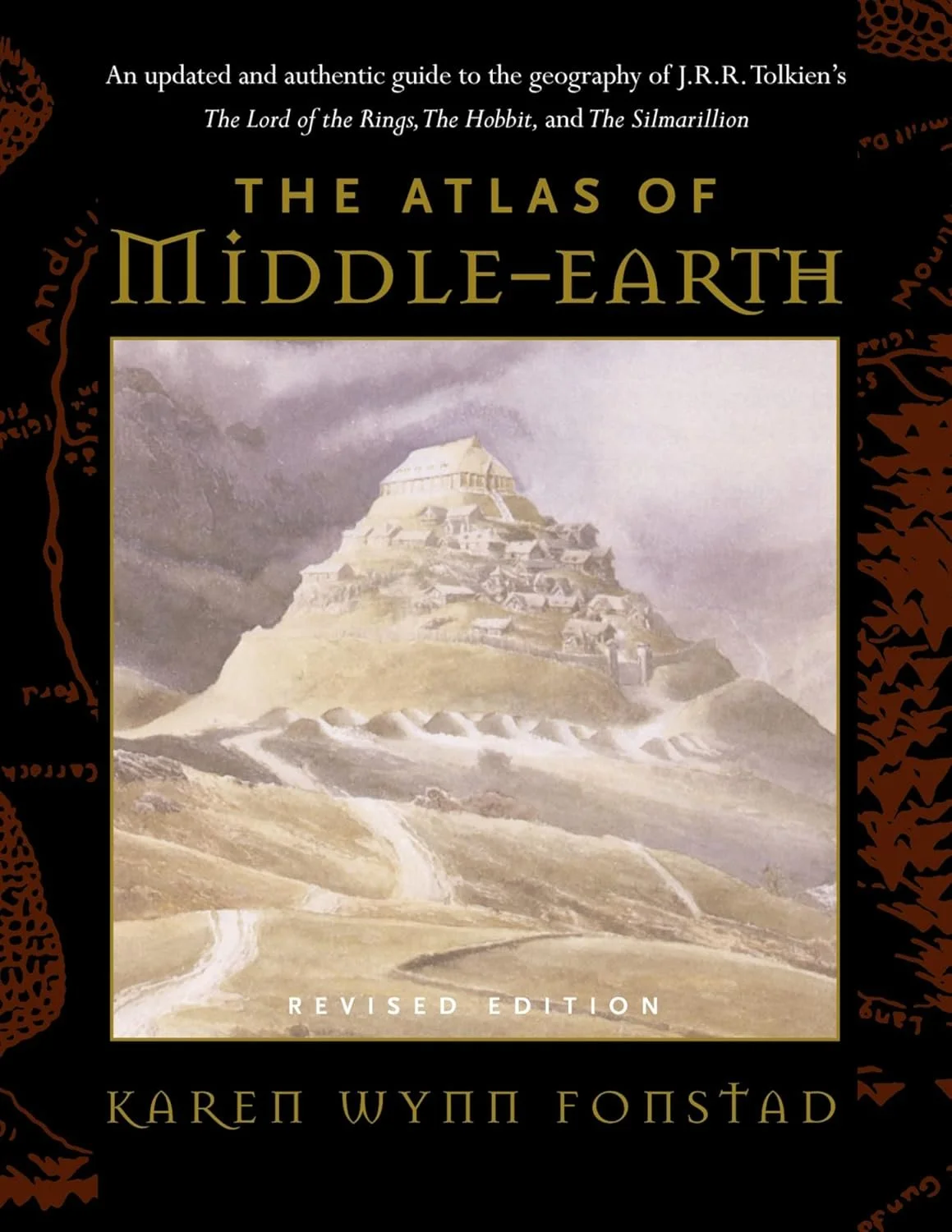
When I first picked up The Lord of the Rings in my middle school library, the maps immediately caught my attention. My imagination is somewhat limited in that I am a very spatial focused person. I need to know where events are taking place in relation to other locations. There are maps in The Silmarillion, but they are not comprehensive enough for my needs. The Atlas of Middle-Earth by Karen Wynn Fonstad provides detailed maps for all of the important locations throughout Tolkien’s works. A physical copy of this book of maps was my constant companion while reading The Silmarillion.
Understanding the Types of Elves
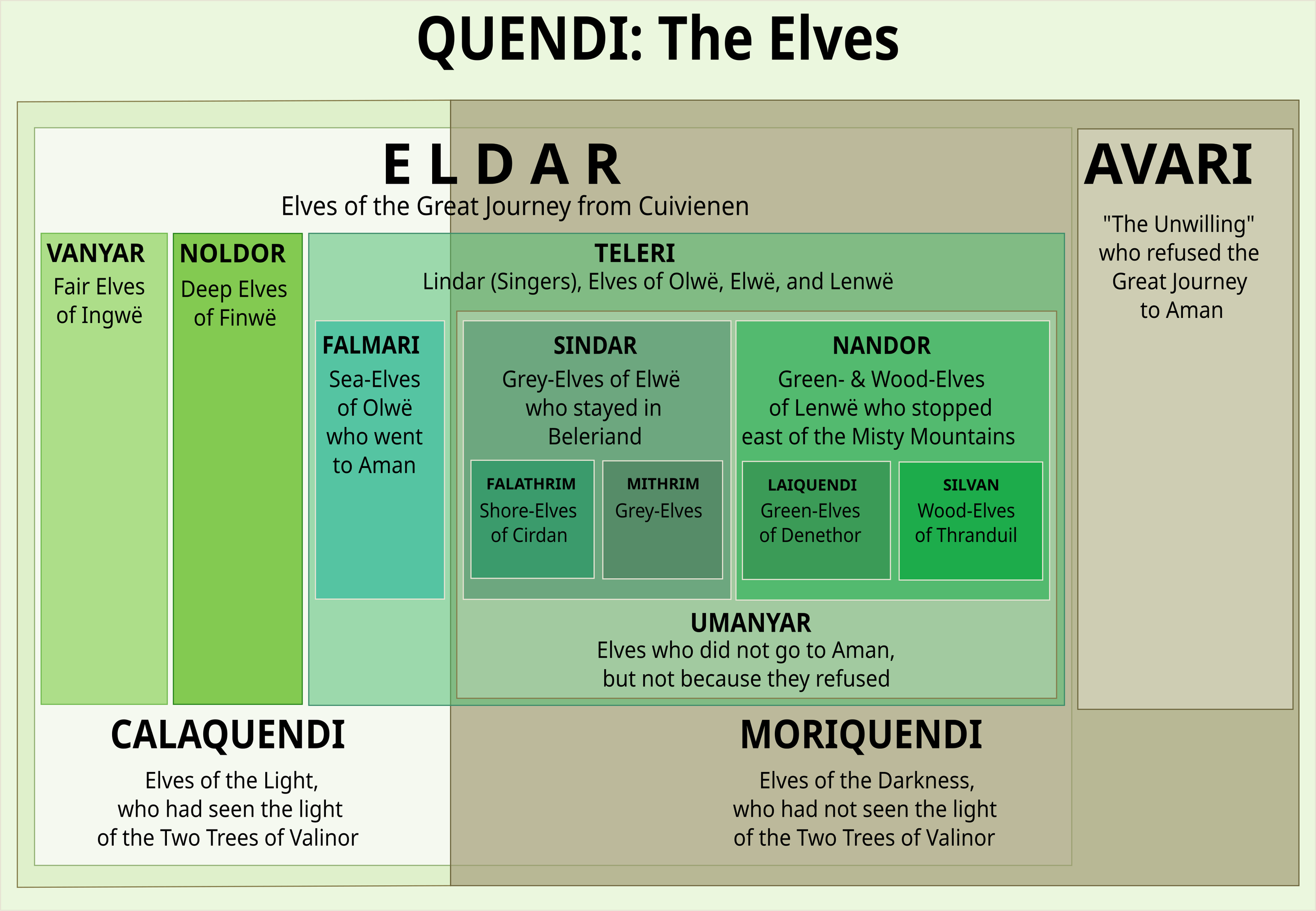
This diagram by Ian Alexander on Wikipedia was extremely helpful with understanding the different types of elves in The Silmarillion.
Citation: Ian Alexander - Own work, based on Dickerson, Matthew (2013) Drout, Michael D. C. , ed. "Elves: Kindreds and Migrations", in In Drout, Michael D. C. (ed.). J.R.R. Tolkien Encyclopedia. Routledge, pp. 152–154 ISBN: 978-0-415-86511-1, and Tolkien, J. R. R. (1994), Christopher Tolkien (ed.), "Quendi and Elyar", in The War of the Jewels, Boston: Houghton Mifflin, ISBN 0-395-71041-3. License: https://creativecommons.org/licenses/by-sa/4.0/deed.en
Elven Genealogy
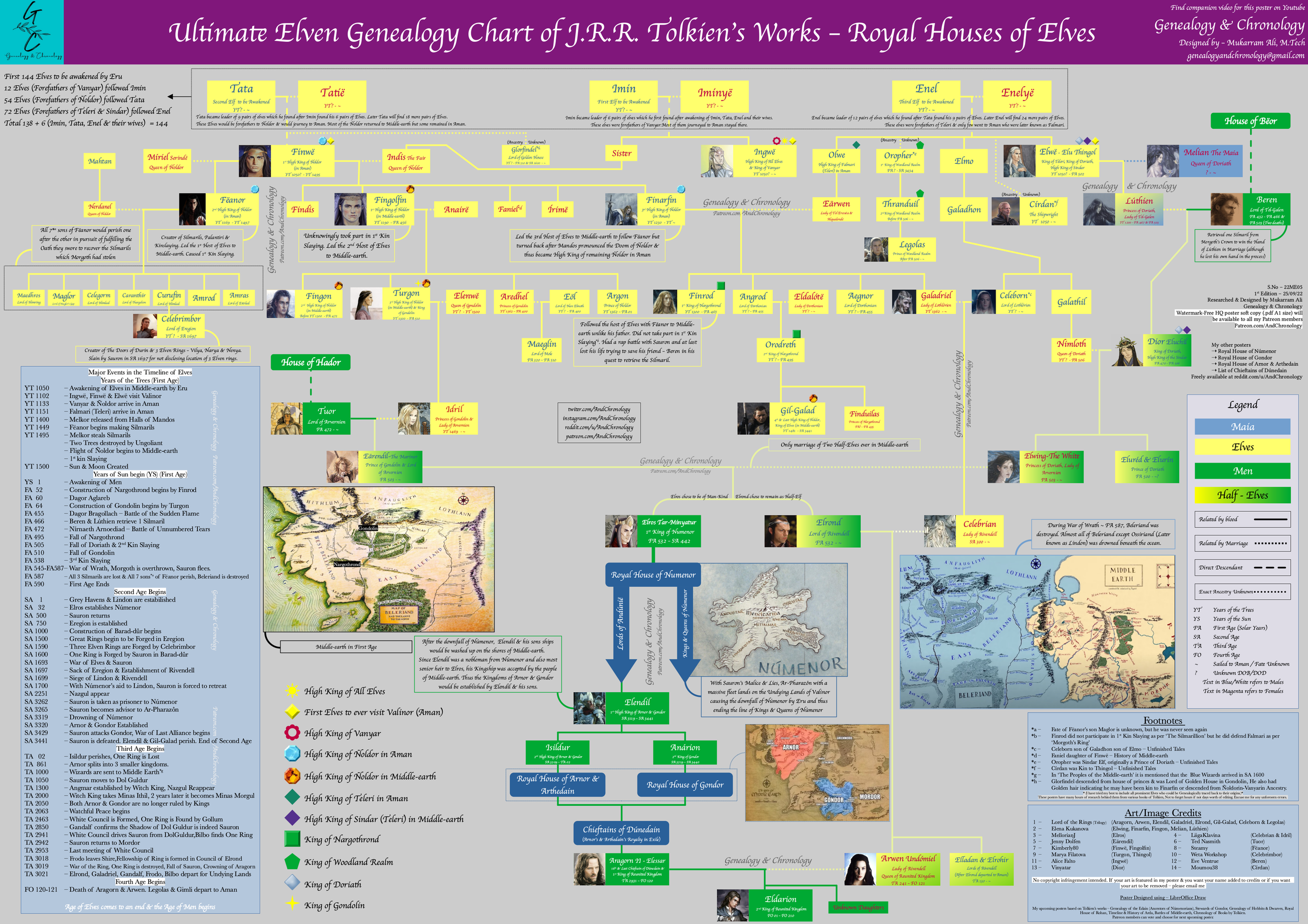
This diagram by Mukarram Ali on Reddit is helpful for figuring out at a glance how different characters are related to each other. The creator goes by “AndChronology” on most platforms.
https://www.reddit.com/r/lotr/comments/xn9tqs/11500_years_of_elven_genealogy_royal_houses_of/ (retrieved June 27th, 2026)
Genealogy of Men
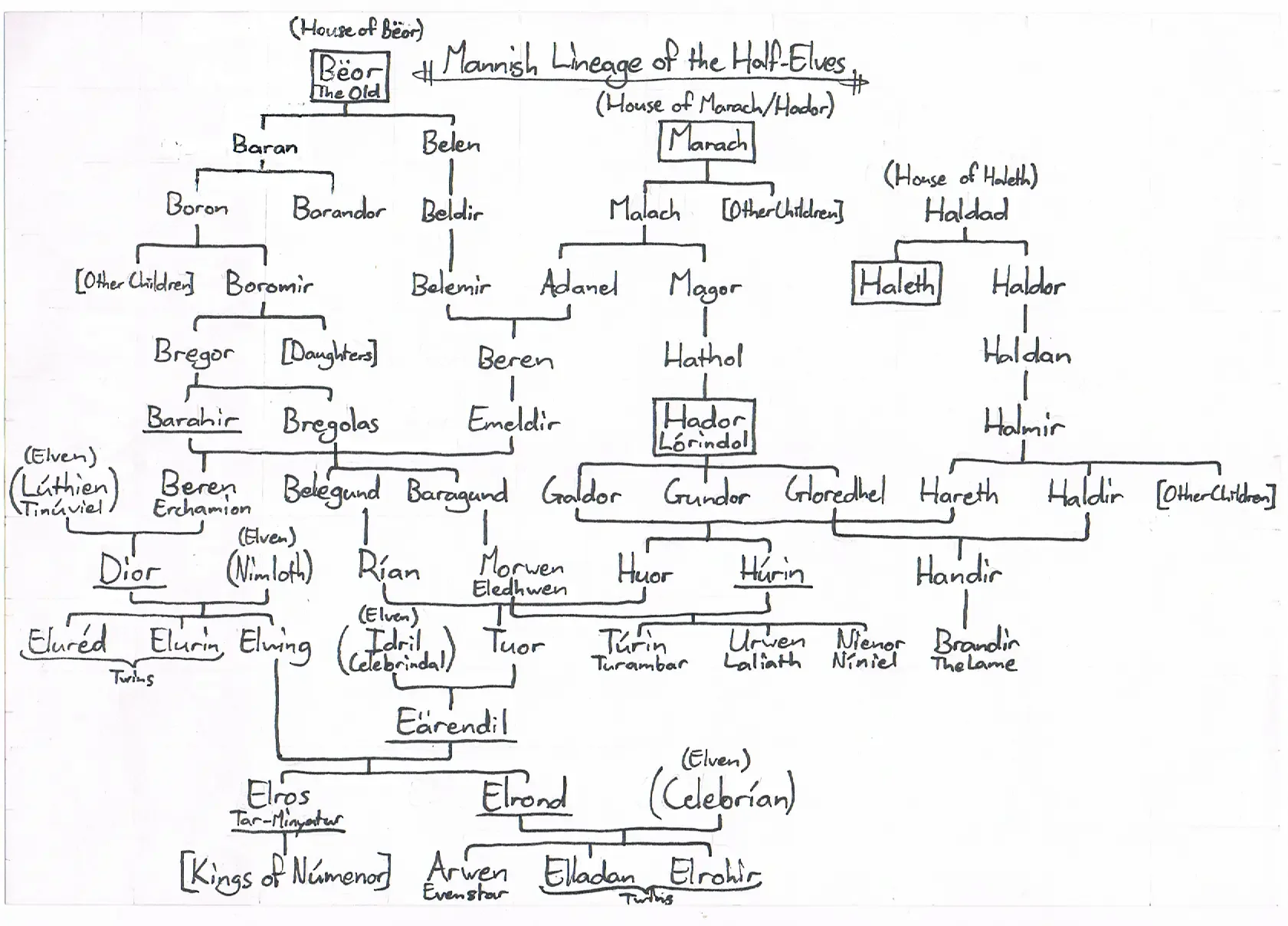
This diagram by user SPACE_LEMON on the Minecraft Midde-Earth website is similarly helpful at remembering how the men in The Silmarillion are related to each other. It’s less polished than the Elven Genealogy diagram, but it gets the job done.
https://www.mcmiddleearth.com/community/threads/my-hand-drawn-genealogies-of-the-lords-of-elves-and-men-in-the-first-age-and-the-half-elves.5645/ (retrieved June 27th 2026)
Tolkien Wiki
I found https://tolkiengateway.net/ a useful resource for learning about any given character, land, or item. The website is comprehensive and not laden with ads.